


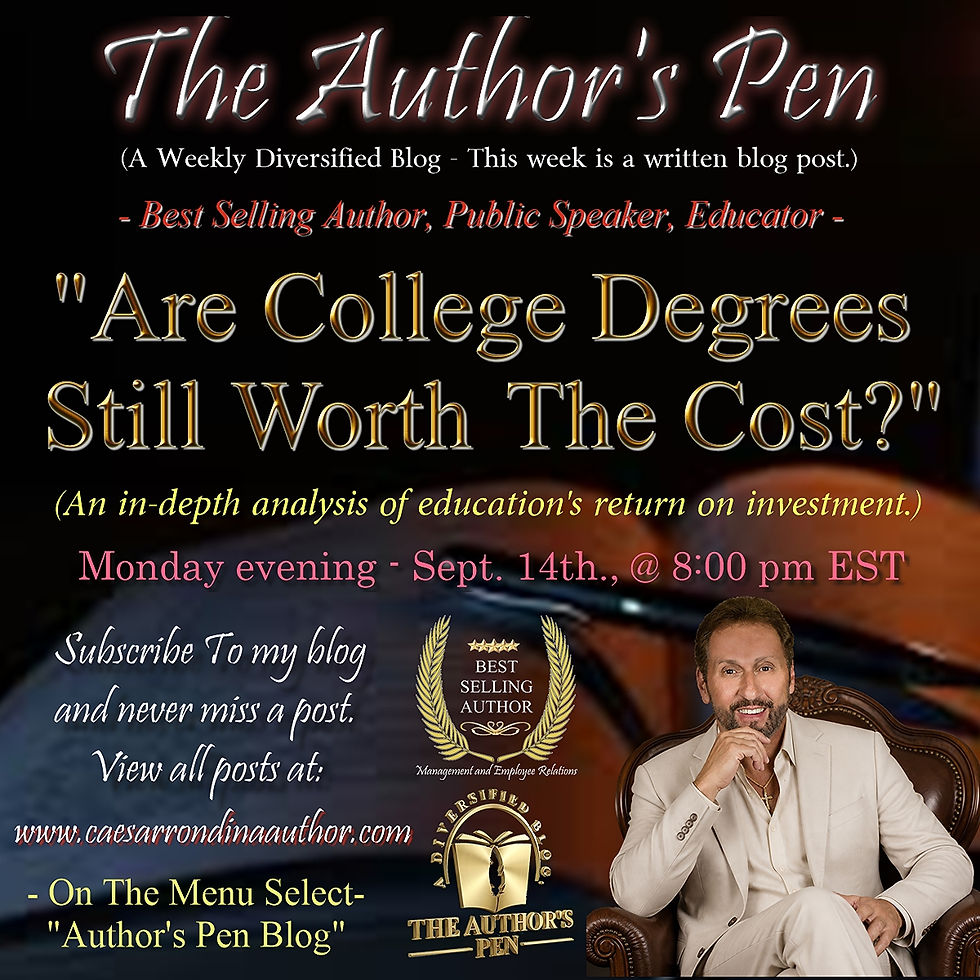
Are College Degrees Still Worth The Cost? - An in-depth analysis of education's return on investment.
INTRODUCTION: College
Greetings. This topic has been controversial for some time. Many parents feel their children aren't getting the education that matches the money they are spending to send them to college. Why wouldn't they feel this way when they watch the news and see what goes on at some college campuses under the umbrella of free speech? I received an email this week from a parent whose child is just starting college as a freshman at a school some distance from home, asking me to discuss this topic. They explained that they have worked for years to pay off their home and now have to remortgage it to help send their child to college. A common story for many.
Their concerns matched what many parents have expressed. Are these college degrees worth the money it costs to obtain them? Why do the schools allow some of the activities that turn to violence on their campus? Why aren't professors concentrating on education rather than discussing the social aspects of the world? These concerns are real and certainly don't apply to every school. Additionally, the cost of a college education depends greatly on the school you attend.
When many of you and I attended college, obtaining a bachelor's degree was worth gold, and the school you attended made it worth even more. With the onset of online learning, which I am not against, bachelor's degrees became commonplace. Now, a master's degree is better, but it's also becoming much easier to obtain. Additionally, some say where you get your post-graduate degree matters more than where you earned your bachelor's degree. Will this eventually mean everyone needs a PhD to get a job? Where will it end? The job market is very competitive when it comes to higher-paying jobs, and the things that gave someone the edge over another potential candidate are now commonplace. What about the quality of the education? Are we losing our skilled labor force?
Another question so many ask is: the number of students that attend our colleges from other countries is getting greater and greater. Is this because their governments pay the bill and then the students go back to their country when they graduate, and our children miss an opportunity because they were financially challenged? I believe everyone should have an equal opportunity to learn. Regardless of where they come from or how they pay. That said, we must also respect other opinions. I don't think it is wrong for another country to send its students to our schools to learn and bring that education back to their country to help make things better. That said, students in our country shouldn't have to suffer for it. For these reasons and more, this is a controversial subject.
So what has college turned into? Well, Sylvester Stallone, who played Dwight Manfredi on Tulsa King in season 1, made this quote. "The whole point of a college degree is to show a potential employer that you showed up someplace four years in a row, completed a series of tasks reasonably well, and on time. So if he hires you, there's a semi-decent chance that you'll show up there every day and not fuck his business up." Tell me, do you agree with that statement? However, tonight, I am focusing on value for the dollar.
ARE COLLEGE DEGREES STILL WORTH THE COST?
As higher education costs continue to rise, many prospective students and their families ask whether a college degree remains a worthwhile investment. While the answer depends on factors such as major, career goals, and personal circumstances, a degree can still offer significant value. To help you make an informed decision, consider the following:
Assess Your Career Goals
Evaluate the Cost vs. Potential Earnings
Research Job Market Trends
Consider Alternative Educational Paths
Utilize Financial Aid Options
Think Long-term
1. Assess Your Career Goals
The first step in determining the worth of a college degree is to reflect on your intended career path. Certain professions, such as medicine, law, and engineering, have clear educational requirements, making a degree essential. For example, aspiring doctors must attend medical school, which requires a bachelor’s degree. Other fields, such as technology, art, or entrepreneurship, may offer more flexibility. Many successful tech entrepreneurs, like Bill Gates and Mark Zuckerberg, left college early and found success without a traditional degree. However, they possessed other significant skills and resources. Create a list of your career goals and the qualifications required for each. This will help you determine whether a degree is necessary or if you can pursue alternative paths.
2. Evaluate the Cost vs. Potential Earnings
Tuition costs have skyrocketed over the past few decades, so a thorough financial evaluation is essential. According to the College Board, the average total cost for in-state public colleges is approximately $27,000 per year, including tuition, fees, room, and board. Those with bachelor’s degrees generally earn significantly more than high school graduates over a lifetime—approximately $1 million more.
Example:
For instance, consider Sally, a recent high school graduate who wants to become a registered nurse. Nursing school may cost around $50,000, but the median salary for an RN is about $75,000 per year. After several years of work, the initial investment could pay off. Use a wage calculator or a return on investment (ROI) calculator to assess the financial outcomes for your chosen field and degree. This will provide a clearer picture of expected salary compared to educational costs.
3. Research Job Market Trends
Beyond potential salaries, researching job market trends is critical. Some fields are growing, while others are stagnating or declining. The U.S. Bureau of Labor Statistics provides job projection data.
Example:
The healthcare field, particularly nursing, is projected to grow by 9% from 2020 to 2030, meaning job opportunities will increase for graduates. On the other hand, traditional roles in print journalism are declining, making a degree in that area less financially advantageous. Follow industry trends through platforms such as LinkedIn, Glassdoor, and the Bureau of Labor Statistics to stay informed on which fields are hiring.
4. Consider Alternative Educational Paths
While traditional four-year degrees benefit many, they are not the only option. Vocational schools, community colleges, and online courses offer less expensive educational paths that can lead to successful careers. For instance, becoming a certified HVAC technician or a web developer may require only a year or two of training, leading to high-paying jobs without the burden of student debt.
Example:
James, facing budget constraints, chose to attend a community college to complete his associate degree in information technology. He found a high-paying job at a tech startup right after graduation, and by working his way up, he could afford to pay off his college debt quickly. Research local community college programs or vocational training that align with your career interests, and weigh those costs against a traditional degree.
5. Utilize Financial Aid Options
Understanding financial aid is crucial to college affordability. Scholarships, grants, and work-study programs can dramatically lower the cost. Many organizations offer scholarships based on academic performance, special interests, sports, or community involvement.
Example:
Sara, a bright student passionate about environmental science, applied for several scholarships that ultimately covered her tuition at a public university. Additionally, she secured a work-study position that provided practical experience and extra pocket money. Actively seek scholarships and grants through websites like Fastweb, and consider reaching out to local organizations for additional financial support. Create a timeline for when to apply to maximize funding opportunities.
6. Think Long-term
While the initial costs of a college education can seem frightening, it's essential to consider the long-term benefits. Recent studies indicate that degree holders are generally more likely to secure stable employment, access health benefits, and enjoy a better quality of life.
Example:
Tom graduated with a degree in accounting and started at an annual salary of $60,000. By networking, seeking professional certifications, and gaining experience, he climbed the corporate ladder. Five years later, he now earns over $90,000 a year—wealth and stability that many of his friends who chose not to pursue a degree have struggled to achieve. Prepare a career plan outlining your goals and how you can achieve them. Factor in the possibility of salary growth, additional certifications, and advancement opportunities when budgeting for your education.
PROS AND CONS OF A COLLEGE DEGREE:

Pros
Higher Lifetime Earnings: Degree holders typically earn more over their lifetimes compared to those without degrees. However, some skilled-labor jobs also command high salaries.
Job Security: Many employers prioritize candidates with degrees, especially in competitive fields.
Skill Development: College enhances not only specific professional skills but also critical thinking and problem-solving abilities.
Cons
Rising Costs: Student debt can be crippling, especially if graduates struggle to find jobs in their field.
No Guaranteed Jobs: The job market is competitive. A degree doesn't guarantee employment in the chosen field, especially in saturated markets.
Alternative Paths: Practical experience, online courses, and vocational training can sometimes lead to quicker job placements.
NAVIGATING COLLEGE COSTS:
Budget Wisely: Create a detailed budget that factors in tuition, living expenses, and future earnings.
Networking is Key: Join student organizations and attend career fairs to expand your professional connections.
Internships Matter: Secure internships, even unpaid, to gain experience and make your resume more competitive.
THERE CAN ALWAYS BE PITFALLS:
Choosing the Wrong Major: Selecting a major without considering job prospects can lead to underemployment after graduation.
Ignoring Debt: Failing to properly assess the long-term implications of student loans can lead to financial distress.
Neglecting Experience: Focusing solely on academic performance without gaining practical experience can be detrimental.
Application of the Decision-Making Process
When Gabby graduated high school, she was uncertain whether to pursue a degree in art history—a field she loved, but that had limited job prospects. Instead of starting a traditional four-year program, she first took community college courses while working part-time in a gallery. This allowed her to assess her passions and gain firsthand experience in the art world. After completing her associate degree, she transferred to a four-year institution and chose a major that aligned more closely with viable career options, such as arts management.
Experimenting and gaining experience before settling into a full degree program could clarify your path and save both time and money. To determine the worth of a college degree, thorough research, financial planning, and career exploration can provide clarity and often show that, while college can be costly, its benefits may far outweigh the expenses in the right circumstances.
Common Issues with the Value of College Degrees
As prospective students weigh the financial burden of college degrees against potential career outcomes, several common issues can complicate their decision-making. Here are some specific, real-world scenarios that illustrate these challenges.
1. Rising Tuition Costs: Samantha, a high school senior, is accepted into a state university. While excited, she soon learns that her annual tuition has increased by 5% compared to the previous year. With student loan interest rates also rising, she must decide whether to take on more debt or attend a community college to save, potentially delaying her career trajectory.
2. Uncertain Job Market: John graduates with a degree in fine arts, only to find that job postings in his field are scarce and vastly competitive. Despite his high academic performance, he struggles to land even an entry-level position. This leads him to question the return on investment of his degree, especially as friends who chose fields like computer science are being courted by tech firms before graduation.
3. Mismatch of Skills and Employer Expectations: Maria completes a degree in sociology and heads straight into the job market, only to find that employers are looking for candidates with specific skills in data analysis and software proficiency. Despite her strong theoretical foundation, she feels underqualified and decides to invest in additional coursework to fill these gaps, increasing her total financial outlay and the time she spends before starting her career.
4. Underemployment: After graduating with a degree in marketing, David secures a job as a retail manager rather than in the agency role he envisioned. Over time, he realizes the position does not use his degree to its full potential, leading to frustration and feelings of being underappreciated. He weighs whether to stay for stability or pursue additional education in hopes of moving into a more specialized marketing role.
5. Online Education vs. Traditional Routes: Elisa, a working mother, opts for an online degree program due to its flexibility. However, she finds the lack of interaction with professors and peers hampering her learning experience. As she balances family and education, she wonders whether the lower cost of the online program justifies its potential shortcomings compared with a traditional, in-person experience at a local university.
6. Debt Repayment Challenges: Mark graduates with a degree in engineering, accumulating significant debt along the way. Shortly after entering the workforce, he discovers his starting salary is lower than expected because the job market in his area is saturated. As his student loan payments begin, he faces a tight budget and must make tough choices, such as delaying homeownership or travel plans that he had previously envisioned post-graduation.
7. Changing Industry Standards: Rachel, who earned her degree in information technology, sees a constant shift in industry standards and technological advancement. Just a few years after graduation, she realizes that some of the programming languages she studied have become outdated. To stay competitive, she faces pressure to keep her skills current through online courses or certifications, adding more costs to her career preparation.
These scenarios illustrate the multifaceted considerations many individuals face when weighing whether a college degree is worth the cost, highlighting the complexity of decision-making in today's economic landscape.
IN CLOSING:
Many factors matter when we consider the cost of a college education and the return on our investment. I believe it is clear that, over time, most will recoup their investment, and many will succeed well beyond that. However, we must plan carefully. The value of a college degree in today's rapidly changing job market is multifaceted and can vary significantly based on individual circumstances, career aspirations, and industry demands. While the financial burden of higher education remains a significant concern for many students and families, the potential for increased earning power, career advancement, and personal growth can still make a degree a worthwhile investment.
Prospective students should conduct thorough research, consider alternative pathways such as vocational training or apprenticeships, and weigh the long-term benefits against the immediate costs. Ultimately, the decision should align with one’s personal goals and values, ensuring that education remains an evolving force in an individual's life, regardless of its price tag. The following are some good questions and answers.
Common Questions Related to Are College Degrees Still Worth The Cost?
Q. Are college degrees seen as essential for high-paying jobs?
A. While many high-paying jobs still require a college degree, there are increasing opportunities in fields like technology and entrepreneurship that may not necessitate formal education.
Q. What are the financial implications of student debt?
A. Student debt can be significant, with many graduates facing monthly payments that can stretch their budgets, making it important to consider the return on investment of a degree before enrolling.
Q. How does a college degree impact employability?
A. Generally, college graduates have lower unemployment rates compared to those without degrees, but skills and experience can also play a critical role in job prospects.
Q. Are there fields where a degree is more valuable than others?
A. Yes, fields such as healthcare, engineering, and education typically place a higher value on formal degrees compared to industries like retail or certain tech positions.
Q. Can online degrees offer similar value to traditional degrees?
A. Many employers are increasingly recognizing online degrees from accredited institutions as equivalent to traditional degrees, especially from established universities.
Q. What alternatives to a college degree exist for career advancement?
A. Vocational training, certifications, apprenticeships, and self-guided learning can provide viable pathways to successful careers without a traditional college degree.
Q. How does the perception of college degrees vary by industry?
A. Some industries place a higher emphasis on degrees due to their complexity and required knowledge base, while others prioritize practical experience and skill sets.
Q. How can one assess the value of a particular degree program?
A. Prospective students should consider factors such as job placement rates, average starting salaries, and industries that value the degree, as well as the total cost of the program.
Q. Are there any long-term benefits to having a college degree?
A. Graduates often enjoy higher lifetime earnings and may have access to better job security and benefits compared to those without degrees.
Q. How can students minimize the cost of their degree?
A. Students can explore scholarships, grants, attending community colleges for general education requirements, and working part-time while studying to help offset costs.
I hope everyone enjoyed my blog post this week. Shares and likes are always appreciated, and so is telling your friends about my blog. While you are on the site, take a moment to subscribe to my blog so you will never miss a post. All we require is your email address. We will never sell or share our subscriber email list. Your privacy is paramount.
You will receive one email each week when I post a new blog, with a link to the post. We would love to have you join our family of subscribers. Click this link to SUBSCRIBE. Please feel free to browse the remainder of the website. The site is undergoing some design changes and will be updated when complete.
I also invite you to subscribe to my YouTube and Vimeo channels, and follow me on Facebook, LinkedIn, Instagram, Truth Social, and "X" (Formerly Twitter), by clicking any of my social media links at the bottom of any page.
Comments are always welcome. If you would like me to discuss a topic or have any questions regarding a post, please email me at crondina@caesarrondinaauthor.com.
I accept guest blog posts from Authors and Writers. If you wish to write an article on a topic, email your finished draft in editable 'Word' format to crondina@caesarrondinaauthor.com. I will review your article and respond. Read the disclaimer below.
DISCLAIMER: All articles submitted by guest Writers or Authors are the property of the Author or Writer. The Writer or Author is responsible for the accuracy of the content they present. The views and opinions in any guest blog post do not reflect in any way the opinion(s) of The Author's Pen Blog or its staff. By submitting an article for publication on The Author's Pen Blog, the Writer or Author grants permission for The Author's Pen Blog to publish the article and will receive no form of compensation for their submission. Further, the Writer or Author grants our editorial staff permission to make any edits to their article that may be necessary to comply with The Author's Pen Blog's policies. The Author's Pen Blog does not support any form of hate speech, violence, antisemitism, or discrimination in any form, and will never post or write articles that exercise these practices. The Author or Writer authorizes The Author's Pen Blog to use their name and article to promote any submitted article for publication.
Thank you.
Be safe, stay well, and focus on being happy today, because tomorrow isn't guaranteed for anyone. Remember to always:
Live with an open mind,
Live with an open heart,
Live your best life.
Best Regards,
Caesar Rondina

VIDEO PRODUCTION WORK:
We produce video book trailers, business ads, and speaker introductions.


Comments